There's a principle that shapes how every session at East London Strength is run: load is there to challenge a movement that already exists. If load changes the movement, it has won.
This isn't a beginner's concern. It applies at every level of training, and it's the reason two people can be doing the same exercise with very different results.
What Load Actually Does
A barbell doesn't teach movement. It tests it.
Put load on a pattern that's already there and it becomes an honest challenge: can you produce and transfer force through a position you already own? That's strength training working as it should.
Put load on a pattern that isn't there yet and something else happens. The body finds a way to complete the movement, because it will always find a way. But the way it finds may not be the one you want. Structures that should be stable bend. Joints that should be transferring force start absorbing it instead. The movement gets done, but not well, and not safely over time.
The performance consequence is not a risk. It's a certainty.
Force leaks wherever stability breaks down. The strength you're trying to build doesn't accumulate in the right places. Progress plateaus, not because you're not working hard enough, but because the architecture isn't there to build on.
The injury consequence is secondary, but it follows the same logic. When a structure that should be providing stability can't, the body finds stability elsewhere. That elsewhere is often not designed for the job.
What every lift asks for
Every barbell lift asks for two things simultaneously.
Stability: the parts of the body that should be stiff and fixed are stiff and fixed. The spine braced, the shoulder blades set, the hips loaded and held. These are the structures force travels through on its way from the floor to the bar.
Mobility: the joints that need to move can move freely and under control. Hips, ankles, thoracic spine. If these are restricted, force generation is compromised before it starts.
Load doesn't create either quality. It reveals whether they're there.
What Load Winning Looks Like
In a squat or a deadlift, spinal movement is the clearest signal that something is off. The spine's job in both lifts is to be still: a rigid column that transfers the force your legs produce up through the body and into the bar. When it moves, that transfer is compromised.
The most common version of this is the hips and shoulders moving at different rates out of the bottom of a squat. The hips rise first, then the shoulders follow. What's happened is that the leg drive has run out before the lift is done, and the lower back has taken over to finish it. The back is now doing a job it shouldn't be doing, with load it isn't positioned to handle well.
The same pattern appears in the deadlift. The bar moves, but the back rounds to get it there. Force is still being produced. But it's being routed through structures that weren't set up to receive it.
Neither of these is catastrophic in isolation. Done consistently, they're a reliable route to plateau and, eventually, injury.
Building the Movement First
Before any load goes on, the movement has to exist. For most people, that process starts with bodyweight.
A bodyweight squat reveals a lot. Can the hips move freely while the spine stays still? Can you get to depth without the pelvis tucking, the knees caving, or the torso pitching forward? For many people, coordinating mobility in the right places with stiffness in the right places is genuinely difficult, even without a bar. That coordination is the skill. Load is just the test of it.
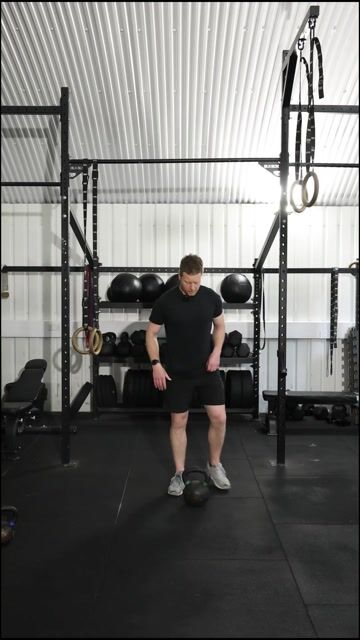
The hinge follows similar logic. A bodyweight hinge, then a kettlebell deadlift, gives you the pattern before the barbell asks for it. The upper back has to stay set while the hips move. The hamstrings load. The spine doesn't flex. Get that under control and the barbell deadlift becomes a natural progression rather than a new problem.
For pushing movements, an incline press can establish scapular stability before horizontal pressing puts it under real demand. Can the shoulder blades stay set through the movement, or do they wing and shift as the load increases?
The question at every stage is the same: does the movement exist yet? If it does, load it. If it doesn't, load won't create it.
Stuart Frew — East London Strength
Stuart has spent over fifteen years helping people move better, feel stronger, and build training that lasts. He works with individuals to apply focused strength training to their goals — endurance athletes, strength athletes, or busy people fitting strength into their lives. His coaching looks to build the capacity to do what matters to you, for a long time, without breaking down. A former Royal Marine, he founded East London Strength and coaches out of Basis Gym in London Fields.